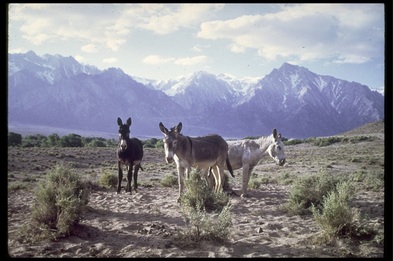
Historical photo courtesy of the Bureau of Land Management, USA
We, none of us, ever know when we are living in the moment that will be pointed to in time to come as the defining moment. We might have a vague feeling that our daily lives are, to borrow from 20th C history, similar to the days of living in the 'tinderbox of Europe' or the last days of the Belle Epoch. But we don't know until the War to End All Wars has come and gone and we are on the other side of it, that we were on a precipice, having 'lived' through the ravages History creates in our lives, whether in families or in nations or in the world wholly. Surely then, as now, there were warning voices for decades before such large scale changes that made "History" took place. And surely then, as now, the people hearing them heeded or ignored, worried and debated, and no doubt felt too small to do much of anything to change the forces of such global change.
I feel strongly that this, too, is one of those times. In observing all the evidence discovered, reported on and written about during my own long career as a conservation journalist, these last 30 years reveal all the signs of warnings, worries, and moments of opportunities gone unheeded by us in meeting the imbalance our industrial society has pressed upon our natural Home and Habitat.
I was going to write about volcanoes and whether they are good or bad for climate change for this blog . . . but I found the geologic and atmospheric research so profoundly sad and the amount we now know about the Earth's natural forces so profoundly amazing, that I instead resolved to look for good, for change, for a moment of brilliance in environmental solutions rather than just more sad, bad news.
After decades of writing about the environment, the wilderness, the Land and loss of wildlife, reporting on such omni-disasters takes its toll on the soul; constantly ringing alarm bells make one as welcome as the original Pandora. A bit — actually a lot — of news that speaks to human creativity and resolve in meeting and solving our challenges is badly needed.
I have in mind to create a new environmental magazine or journal, much in the pattern of our fabulous Buzzworm, to be titled Re/Solve. It will focus on solutions — to conservation disasters, micro- and macro-shambles occurring, whether in village, city, valley, wilderness or range — offering not just the small and mostly insufficient actions offered elsewhere, but real solutions to real global problems. There are so many great minds working on these.
And in setting out on this course, I found this recent Ted talk by Allan Savory. . .
Ironically, I met Allan Savory over 25 years ago — when as a young staff reporter for Newsweek, I was trying to change national journalism from within to create a 'news-beat' on environmental and conservation issues, and on environment as national (and international) security. It hadn't really been done at the national scale in the late 1970s and early 1980s and certainly not by a female back then.
In attempting this, I relentlessly sent 'environmental' stories to my beleaguered and patient editors at Newsweek, Allan being among the many. While I wrote 5,000 word articles on the emerging, complex environmental issues, my editors dutifully reworked them into 750-word boxed features, save for drought and desertification of our nation's agricultural lands. For that we achieved an award-winning cover article and I an early reporting award.
Allan had recently emigrated from Zimbabwe and was working on the damaged and desertified rangelands of my native Rocky Mountain West. His ideas for ending desertification of rangelands were shocking at the time – more livestock, not less — but I watched as his calm insistence in hotel conference rooms and meeting halls, small town by small town, won over ranchers throughout the Intermountain West.
Now I see here that Allan has an idea — a brilliance based on his life's very important work — that will no doubt prove to be an even more important answer to climate change, writ global.
He offers an approach, a solution, a something regions, localities, individuals and nations can do. And his calm insistence that he is profoundly right demonstrates the kind of resolve I hope to grace the coverage of my forthcoming dream project of Re/Solve. What goes around ... goes around.
Take time to absorb this great solution, as nearly a million others watching TED already have... For Allan, it represents a lot of years of work. Thank you for your persistence, Allan!
http://www.ted.com/talks/allan_savory_how_to_green_the_world_s_deserts_and_reverse_climate_change.html
I'll be posting this at my other bloc: Earth: Sacred/Possession as well, because it's so important...
I feel strongly that this, too, is one of those times. In observing all the evidence discovered, reported on and written about during my own long career as a conservation journalist, these last 30 years reveal all the signs of warnings, worries, and moments of opportunities gone unheeded by us in meeting the imbalance our industrial society has pressed upon our natural Home and Habitat.
I was going to write about volcanoes and whether they are good or bad for climate change for this blog . . . but I found the geologic and atmospheric research so profoundly sad and the amount we now know about the Earth's natural forces so profoundly amazing, that I instead resolved to look for good, for change, for a moment of brilliance in environmental solutions rather than just more sad, bad news.
After decades of writing about the environment, the wilderness, the Land and loss of wildlife, reporting on such omni-disasters takes its toll on the soul; constantly ringing alarm bells make one as welcome as the original Pandora. A bit — actually a lot — of news that speaks to human creativity and resolve in meeting and solving our challenges is badly needed.
I have in mind to create a new environmental magazine or journal, much in the pattern of our fabulous Buzzworm, to be titled Re/Solve. It will focus on solutions — to conservation disasters, micro- and macro-shambles occurring, whether in village, city, valley, wilderness or range — offering not just the small and mostly insufficient actions offered elsewhere, but real solutions to real global problems. There are so many great minds working on these.
And in setting out on this course, I found this recent Ted talk by Allan Savory. . .
Ironically, I met Allan Savory over 25 years ago — when as a young staff reporter for Newsweek, I was trying to change national journalism from within to create a 'news-beat' on environmental and conservation issues, and on environment as national (and international) security. It hadn't really been done at the national scale in the late 1970s and early 1980s and certainly not by a female back then.
In attempting this, I relentlessly sent 'environmental' stories to my beleaguered and patient editors at Newsweek, Allan being among the many. While I wrote 5,000 word articles on the emerging, complex environmental issues, my editors dutifully reworked them into 750-word boxed features, save for drought and desertification of our nation's agricultural lands. For that we achieved an award-winning cover article and I an early reporting award.
Allan had recently emigrated from Zimbabwe and was working on the damaged and desertified rangelands of my native Rocky Mountain West. His ideas for ending desertification of rangelands were shocking at the time – more livestock, not less — but I watched as his calm insistence in hotel conference rooms and meeting halls, small town by small town, won over ranchers throughout the Intermountain West.
Now I see here that Allan has an idea — a brilliance based on his life's very important work — that will no doubt prove to be an even more important answer to climate change, writ global.
He offers an approach, a solution, a something regions, localities, individuals and nations can do. And his calm insistence that he is profoundly right demonstrates the kind of resolve I hope to grace the coverage of my forthcoming dream project of Re/Solve. What goes around ... goes around.
Take time to absorb this great solution, as nearly a million others watching TED already have... For Allan, it represents a lot of years of work. Thank you for your persistence, Allan!
http://www.ted.com/talks/allan_savory_how_to_green_the_world_s_deserts_and_reverse_climate_change.html
I'll be posting this at my other bloc: Earth: Sacred/Possession as well, because it's so important...
 RSS Feed
